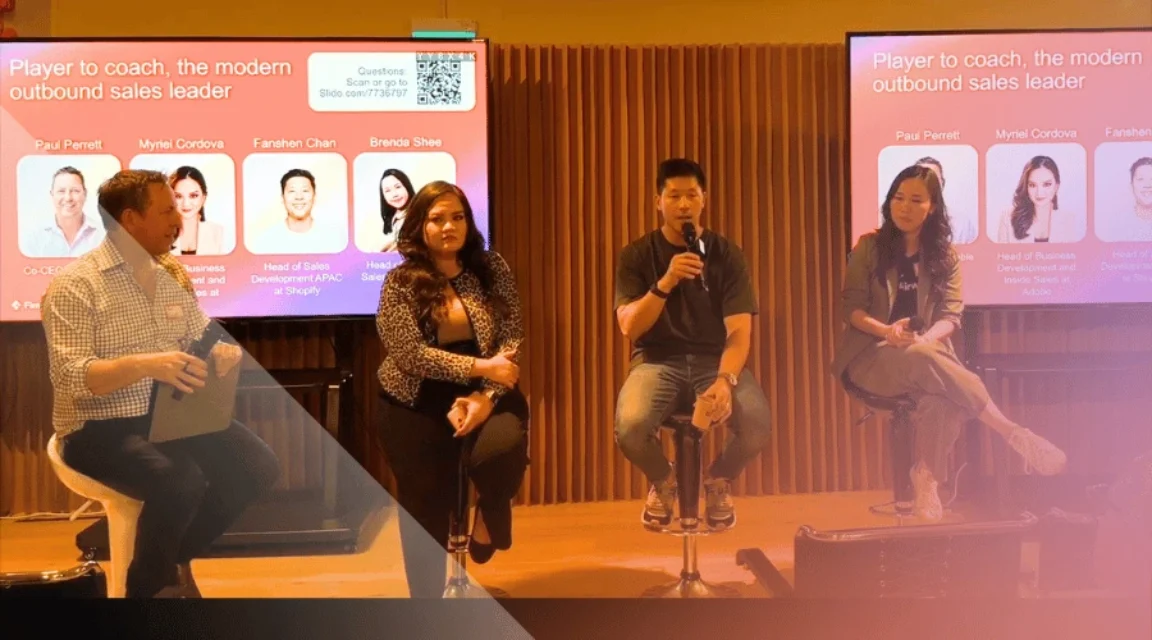

150+ people showed up in Singapore last week for Firmable’s fireside chat, “Player to coach: the modern outbound sales leader.” I was running the mic for the audience Q&A, and honestly, the room had the same energy I feel every time I walk onto our Melbourne sales floor. People leaning forward, taking notes on their phones, acknowledging things that clearly hit home.
Our co-CEO Paul Perrett hosted three people who actually run outbound at scale in this region: Myriel Cordova (Head of Business Development and Inside Sales, Adobe), Brenda Shee (Head of Outbound Sales, Airwallex), and Fanshen Chan (‘Shen’ – Head of Sales Development APAC, Shopify).
I’ve sat through a lot of panel discussions over the years. This is one I kept nodding along to. Here’s what stuck.
The bit that’ll save you the most pain: Stop treating APAC like one market
This came up so many times I lost count. Myriel Cordova said it straight – one of the biggest mistakes an American company makes is walking into APAC and treating it like a single market. Australia and Indonesia aren’t the same conversation, let alone the same funnel.
Shen took it further with something I’m going to keep repeating to people: there’s no such thing as one clean, single view of your metrics across APAC. In the US, you’ve got one language, one set of channels, roughly one buying behavior. Across APAC you’ve got Singapore and Southeast Asia running heavy on WhatsApp, Japan still living in email and offline conversations, and completely different cadences everywhere in between. You benchmark regions against themselves. You don’t force everyone onto the same average and call it a day.
Brenda Shee added the piece I think a lot of people skip past – trust. Sales in Asia leans on relationships to an extent that US sales doesn’t have to. Traditional Singapore SMEs aren’t buying because your product is objectively better. They’re buying because they trust you. That’s exactly why her team still runs a heavy cold-call sequence for that segment instead of the mass-email motion that works fine elsewhere.
Paul’s stat from the floor stuck with me too – connect rates on cold calls sit around 1-2% in the US off huge parallel-dialler volume, climb to 10-20% in Australia off way fewer calls, and look completely different again in Japan. Same motion. Three different worlds for the outbound sales leader to navigate.
How the three teams are actually built (for context):
- Shopify runs sales pods – SDR, AE and solutions engineer sharing a book of 500-1,000 accounts, roughly half the week on outbound and half on high-intent inbound.
- Airwallex segments Singapore by vertical, then breaks big verticals like retail into sub-segments so it still scales as headcount grows. The product wedge changes per vertical too – payment acquiring for retail, FX solutions for manufacturing.
- Adobe splits by lifecycle – protecting a massive existing customer base on one side, a tight ICP for net-new on the other.
- We run more transactional, in-market, with SDRs in pods of six or seven rather than pairing one-to-one with an AE.
The AI story isn’t writing your emails, it’s telling you who to call first
This is the part I could talk about all day, so I’ll keep it tight.
Shen said something that matched exactly what I see building this stuff – a few years ago, a good rep given 500 accounts would just work the whole list. Today that’s the wrong move. The value is pulling every signal you can (news, annual reports, job changes) and using it to load a rep’s Monday with the top 50 accounts that actually matter, not all 500 treated equally. He reckons 50-60% of the outbound process can be automated in some form today.
Airwallex is running the same logic top-down. Brenda’s team applies AI scoring at territory design so every rep starts with a better book, then again at the rep level for drafting and intent signals. And the metric she watches isn’t activity. It’s whether reps are spending more time on revenue-generating work and less on admin.
We’ve literally just shipped our own version of this internally – an AI account allocation model that scores and surfaces next-best accounts for our SDRs. Early days, but it’s already the same story everyone on that panel was telling: account allocation is one of the biggest wins in outbound, and it gets genuinely hard to do well by hand once a team scales past a certain size.
Myriel was the voice of caution the room needed, and I appreciated it. Her line: using more AI isn’t the goal. The real question is what a rep does with the time it frees up. Adobe doesn’t ration tokens internally, but the discipline is entirely about avoiding vanity metrics and asking whether an AI use case is actually moving pipeline. She also mentioned something that stuck with me – an AI grading rubric scored some of Adobe’s recorded demos at 95-100, and several of those recordings wouldn’t have passed her own bar as a leader. AI can set a baseline. It shouldn’t replace your judgement on whether the output’s actually good.
Shen flagged a second risk I hadn’t thought about this way before – reps quoting a one-shot AI-pulled stat in a mid-quarter review with zero context behind it. He thinks most orgs will spend the next 12-24 months cleaning up the data integrity mess that AI has exposed, not caused.
And when Paul asked how the outbound sales leader’s job has actually changed over the last two or three years, the answer from the panel was unanimous: it’s got harder. When volume alone could land a meeting, more calls and more reach won. Now everyone’s got the same tools, so that edge is gone, and the job’s become about helping reps bring something a template genuinely can’t replicate.
Hiring: Nobody on the panel led with tool skills
None of the three lead with CRM experience or tool fluency when hiring. They lead with traits.
Brenda looks for hustle and velocity above everything, and tests for it with personality-style interview questions built to separate who’s genuinely driven from who’s coasting.
Shen hires reps at Shopify with 2-3 years of experience rather than fresh grads, and looks for three things in order – mindset (grit, persistence, staying positive), process (can you explain how you’d work backwards from a number to a plan), and business acumen.
Myriel, drawing on what she learned at LinkedIn, hires for transferable capability over direct experience – grit, coachability and growth mindset, and what she calls the X factor, the thing a candidate brings that nobody else on the team has. She’s hired ex-lawyers and ex-accountants into sales roles on exactly that basis.
On when to let someone go, Brenda’s answer was refreshingly unglamorous – a performance improvement plan and a 360 review before any final call, because it’s genuinely hard to justify exiting someone if the rest of the team rates them well. The real signal is when someone isn’t coachable and the feedback around them is unanimously poor. Paul added that in practice it’s often a mutual conversation. Sometimes someone just doesn’t enjoy the role once they see what it actually involves day to day.
The actual “player to coach” jump
Given the event’s title, I thought this was the most useful ten minutes of the night.
Myriels’s approach was basically a manifesto – make your ambition known to the people who actually make the call, master your current role well beyond what’s expected of you, and act the part before you hold the title. She was helping her manager hire and interview and build process long before she had the job. When the role opened, she was the obvious internal pick, not one of several people fighting for it.
Brenda’s route was self-directed – reading on people management, and pitching proposals beyond her scope on team structure and how she’d lift results, well before she had the title to back it up.
Shen’s answer was the one nobody expects – go join a startup. If you’ve built a track record somewhere established but there’s no path up internally, an early or growth-stage company that needs strong commercial leadership is a genuinely lower-risk way to get that experience and be part of a growth story.
And on how you know SDR leadership is actually for you, Myriel’s test was the cleanest thing said all night: if you can stop caring primarily about your own success and genuinely want to drive other people’s success, the role of outbound sales leader is for you. She took a pay cut moving into management, given the comp caps at that level, and did it anyway because she wanted to help people grow. Brenda pointed out management and AE aren’t the only two doors out of an SDR seat either – AM, CSM and inside sales roles are all on the table. Talk to people in those roles before you decide.
Quickfire round (this is where it got really good)
The audience Q&A at the end is where the most practical, usable stuff came out.
Standing out when everyone’s outreach looks the same: Myriel’s advice – write your own first draft, or heavily edit whatever AI gives you, and add something AI genuinely can’t find, like a joke or a real shared connection. Shen keeps what he calls a skills file – the best-performing emails and cadences across the funnel, updated weekly or monthly, rewritten in her own voice. His test for any message: would you personally open it, and if you did, would it get you to book the meeting? If not, don’t send it.
Segmenting SMBs with a big product set: Brenda’s team assigns each rep a vertical, then splits large verticals like retail into sub-segments so it keeps scaling. The pitch changes with the vertical too – payments for retail, FX for manufacturing – because that’s what those businesses actually need.
Is cold calling still worth it? Unanimous yes from the panel. Brenda’s line was especially sharp – in Singapore, cold calling is the only way to prove you’re actually human, not another AI touch. Myriel backed it up with her own story – she agreed to talk to Firmable in the first place because one of our SDRs cold called her, found her number, and opened with something specific about her role instead of a generic pitch. Can’t argue with that.
FAQ: Quick answers, if you’re skimming
“Player to coach: the modern outbound sales leader” was our fireside in Singapore with outbound and sales development leaders from Adobe, Airwallex and Shopify, covering regional GTM, AI in the outbound stack, and hiring the modern SDR.
Paul Perrett hosted Myriel Cordova (Adobe), Brenda Shee (Airwallex) and Fanshen ‘Shen’ Chan (Shopify).
Treating APAC as one market. Connect rates, channels, and how much trust matters in the sale all shift dramatically across Australia, Japan and Southeast Asia.
Account and contact prioritization, more than content generation – pulling signals like news, funding, and job changes to load a rep’s week with the accounts most worth their time.
Not even close, according to all three sales leaders. If anything, it’s become the clearest signal that a human is actually behind the outreach.
Grit, coachability, hustle and business acumen, well ahead of tool or CRM experience. Two of the three panellists explicitly hire for transferable traits over sales background.
Make your ambition known early, master your current role beyond what’s expected, and start acting like the leader (helping with hiring, process, reporting) before the title exists.