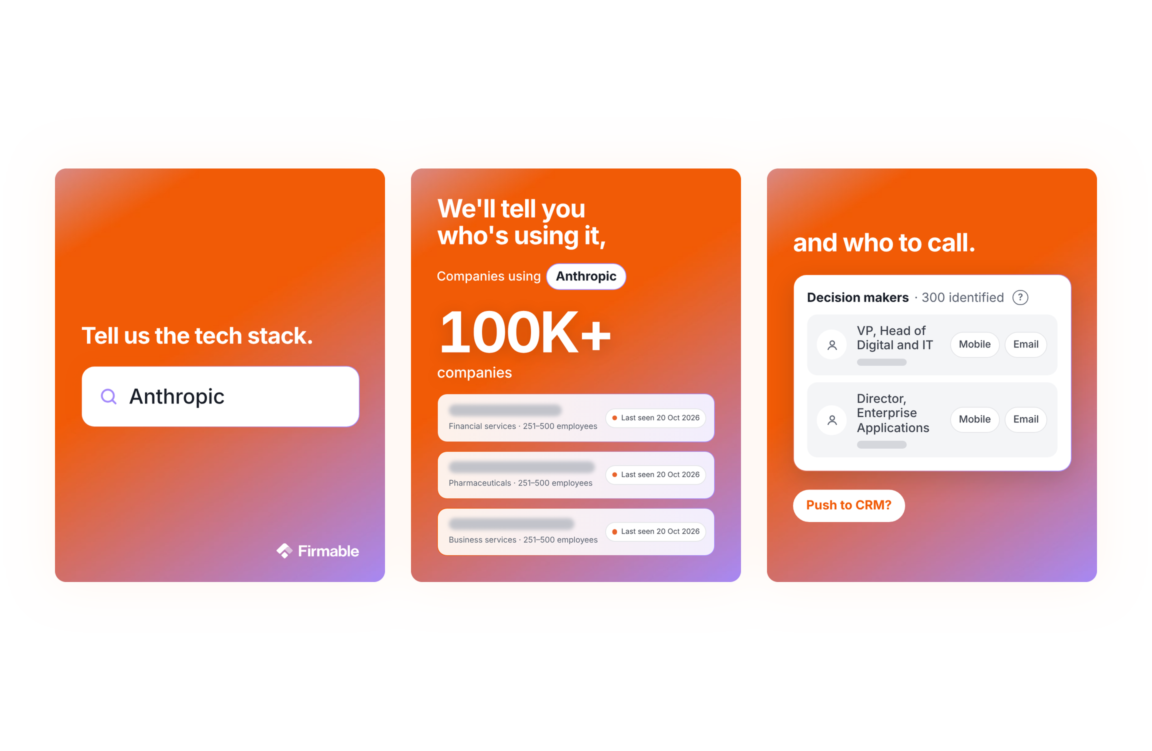

Technographic data is information about the technologies a company runs: its software, cloud services, infrastructure and AI tools. B2B sales teams use it to find accounts that already run a competing product, a complementary one, or a system they can service. As of 21 October 2026, 124,180 companies were observed running Claude.
The term is a blend of technology and demographics. Where demographic data describes people and firmographic data describes companies, technographic data describes the stack a company has chosen to build its operations on.
That choice is unusually revealing. A company running a particular CRM has made a decision about how it sells. A company running a specific ERP has made a decision about how it handles money. Those decisions are expensive to reverse, which is exactly why knowing about them before a conversation changes what that conversation can be.
What counts as technographic data?
A technographic record answers one question: what is this company running?
In practice that spans four layers. Cloud and hosting, meaning where the business runs and how it routes traffic. Software, meaning the applications it uses day to day. Hardware, meaning the servers, systems and network gear underneath. And increasingly AI, meaning the models and tools companies are adopting right now.
A single detection is a small fact: company X appears to run technology Y, observed on a date, at a confidence level. Scale is what makes it useful.
How is technographic data different from firmographic and intent data?
Three categories, three different questions.
Firmographic data asks who a company is: industry, size, revenue, location. Technographic data asks what it runs. Intent data asks what it is doing right now, through signals like hiring activity, funding or research behavior.
They are strongest together, and weakest alone. Firmographic data qualifies fit. Technographic data qualifies compatibility, whether there is something to replace, extend or support. Intent data qualifies timing. An account that fits perfectly on paper with no current signal is a nurture account, not a priority.
Our guide to firmographic data sets out the full comparison, including how quickly each category goes stale. Technographic data decays faster than firmographic data, because companies change tools more often than they change industry or headquarters.
What does technographic data look like in practice?
Here is a live example rather than a hypothetical one.
As of 21 October 2026, companies using Claude numbered 124,180 across the 13 countries tracked by Firmable. Of those, 123,071 were confirmed in the preceding 90 days.
| Market | Companies observed running Claude |
|---|---|
| United States | 107K+ |
| Canada | 31K+ |
| Australia | 31K+ |
| Singapore | 13K+ |
| New Zealand | 9.5K+ |
Source: Firmable Tech Intelligence, observed 21 October 2026.
The shape of that population is as useful as its size. On the same figures, the most common company size is 51 to 250 employees, at 32% of the total. The leading industries are information technology and services at 32K+, professional and business services at 17K+, and financial services at 13K+.
For comparison, companies using ChatGPT numbered 162,389 on the same date. Both sit inside the wider set of AI and machine learning technologies.
That is what technographic data is. Not a definition, a population you can filter, size and act on.
How is technographic data collected?
The useful question is not where the data came from. It is what kind of claim it is.
Most traditional technographic data providers work from inference. A job ad asks for administration experience in a named platform, so the platform is probably in use. A script tag sits on the marketing site, so the tool behind it is probably live. These are reasonable deductions from things a company has published, and they are genuinely useful. They are also a reading of what a company says about itself, which arrives on the company’s timetable and covers only what it chose to put outside. A hiring post can trail real adoption by months.
Firmable Tech Intelligence works from observation. It reads the public-facing infrastructure itself: DNS records, open ports and other signals a company exposes across the internet. Scanning runs continuously, and every detection is cross-checked against independent methods. In the product’s own words, what you act on is evidence of what is running, not an inference from a careers page.
The distinction is not pedantic, because it changes what you can know. A marketing site tells you what a company wants understood about its stack. Infrastructure tells you what is actually answering requests. The gap between those two is where the back office lives: finance, identity, mail, hosting, the systems a business runs on and never writes a landing page about.
Everything surfaced by Firmable Tech Intelligence is public-facing. The AI never uses a login and never goes inside a company’s network.
How do you know a detection is right?
Collection is only half of it. What you do with a detection depends on how much weight it can carry, and three things establish that.
A confidence score. Every technology carries a high, medium or low score at company level, so you can decide how much weight a detection deserves rather than treating every row as equally true.
Agreement between independent methods. Detections are cross-checked across methods that do not share a failure mode. One method finding something is a hint. Two independent methods finding the same thing is the evidence. That is what triangulation buys you: not more data, but data that can confirm itself, or disagree with itself and be caught doing it.
A last-observed date. Every detection says when the evidence was last seen. This sounds minor and is not. Most technology data arrives as a bare fact with no date attached, which means you cannot tell a detection made last week from one made two years ago. A stack from 2024 is not wrong, exactly. It is just no longer a reason to pick up the phone.
What a detection does and does not tell you
Being precise about the limits is the fastest way to use it well.
| A detection tells you | A detection does not tell you |
|---|---|
| A technology appears to be present at a company | How widely it is used inside that company |
| When it was last observed | How many seats or licenses are in play |
| How confident the detection is | What the contract is worth, or when it renews |
| Which independent methods agree | Whether anyone is actively unhappy with it |
Treat detections as probable rather than definitive. A company appears to run something; you do not know that it does. And where a company leaves no public trace of a tool, no method will find it. That is a real limit, not a temporary one.
Why is technographic data alone not enough?
A list of companies running a technology is a starting point, not a reason to call. It tells you an account is a candidate. It does not tell you it is a candidate today, and it does not tell you who to speak to.
That is the part most technographic data leaves to you. You export a list, take it somewhere else to find contacts, and still have no idea which of the 400 accounts is worth a call this week.
Three layers answer three different questions, and they only work stacked:
| Layer | The question it answers | On its own |
|---|---|---|
| Technology | What does this company run? | A list of candidates |
| People | Who owns it, and how do I reach them? | A list of names |
| Signals | What changed, and is now the moment? | A list of events |
This is usually a RevOps problem before it is a rep problem. Someone has to stitch technographics, firmographics and contacts together across three tools, keep them in step, and explain why the counts never match. The rep just sees a list that is hard to trust.
Firmable joins all three. A technology detection arrives with the verified contacts attached from the same B2B database, so there is no second tool and no re-enrichment step. Buying signals then sit on top: job changes, funding rounds, company growth, technology adoption and social activity, which can trigger a task in your CRM rather than an email nobody opens.
The strongest plays pair a detection with a second signal. A company running a particular platform is a candidate. A company running it that just hired a head of IT is a conversation. The detection finds the account; the signal picks the week.
This is also why technology adoption works as a signal in its own right. A stack change is one of the few events that reliably precedes a buying decision, because the company has already decided something is not working.
How do B2B sales teams use technographic data?
Four plays account for most of the value.
Competitor displacement. Find every account running the product you replace, then work the list. This is the clearest use and usually the first one teams try, because the qualifying question is already answered before the call.
Complementary tools. Find accounts running something your product extends. If you sell an add-on, the companies running the platform it attaches to are a better starting population than any industry filter.
Service partners. Find accounts running the technology you implement, migrate or support. A partner specializing in a particular virtualization platform wants the companies running it, not a list of similar-sized businesses.
Market insights. Size a market before committing to it. Counting the companies running a technology by country, industry and size turns a guess about addressable market into an arithmetic problem, which is the use case the Claude figures above illustrate. It also gives you a denominator: the Australian Bureau of Statistics counted 2,814,778 actively trading businesses in Australia at 30 June 2026, so a technology running at 31,000 Australian companies sits at roughly 1% of the market.
All four turn on context before contact, and the timing research explains why that matters so much in this region. Green Hat’s APAC B2B Buyer Research Report 2025, covering 632 B2B organizations across Singapore, Hong Kong, Australia, New Zealand and Southeast Asia, found that 60% of the buying journey is over by the time the buyer engages a vendor, and that 76% said the first vendor contacted usually wins the business.
Read those two together and the job changes. If most of the decision happens before the first conversation, and the first vendor in usually wins, then the advantage is not in the pitch. It is in knowing which accounts to approach and when, before anyone raises a hand.
A sales lead at a property technology company described the problem from the other side:
“It has always been hard to get info before the sales call on what tools people have. You’re lucky to get the meeting, and then you mostly find out in the meeting what they’re using. Now that I know what their tech is before I go in, I sharpen my pitch to the real pain point. That has helped put at least two deals in motion this month.”
Their point was not that previous meetings went badly. It was that the strategy for them was set too late.
The same gap shows up in the United States, with a sharper edge on depth. A sales leader at a US construction technology company put it in terms of a single vendor’s product line:
“I don’t really care if you’re HubSpot Core, but I care if you’re HubSpot Breeze Agents… how do you get down to that level?”
Two products from the same vendor, and only one of them tells him whether there is a deal. Knowing a company runs a vendor is often not the answer. Knowing which product, and whether it is the one you displace or the one you extend, is.
His team had hit the limits of inference on their own accounts. The hard part, as he put it, was the mid-market, “where not all of this stuff’s public”.
Who uses technographic data?
Two roles tend to own this. Sales leaders care because it decides which accounts their team works and how a first conversation opens. RevOps cares because it decides whether the data arrives in one piece or has to be assembled every quarter.
Four kinds of company get the most out of it, and they share a trait: their next deal depends on what the prospect already runs.
Technology vendors use it to displace an incumbent, or to target users of a product theirs extends.
Managed service providers and IT services firms use it to find refresh and migration work before anyone issues a tender. Cyber and managed security providers target by installed security stack. Resellers and partner teams go after the customers of the vendors they already sell.
The common thread is simple. Their next deal depends on what the prospect already runs.
Teams with no tech-related use case get less from it. If what you sell has no relationship to a prospect’s stack, technographic data is interesting rather than useful.
What should you look for in a technographic data provider?
Six questions separate providers quickly.
Coverage in the markets you sell into. Many datasets thin out badly outside the United States and Western Europe. If you sell into Australia, New Zealand or Southeast Asia, test those markets specifically rather than trusting a global total.
Update frequency. Ask when a detection was last observed, not when the database was last refreshed. Those are different claims.
Confidence scoring. A provider that returns every detection with equal certainty is hiding the uncertainty rather than removing it.
Contact data joined to it. Finding the account is half the job. If you then have to enrich it somewhere else to get a name and a number, the workflow has a hole in it. A B2B database that carries both removes a step.
Signals layered on top. Ask whether the provider can tell you what changed, not only what is present. A dataset that is accurate and static still leaves you guessing about timing.
CRM integration, and access beyond it. A list you cannot push into the system your team works in will not get worked. Ask how the data reaches you: a CRM sync covers the rep workflow, while an API or MCP connection is what lets RevOps and AI agents query it directly rather than waiting on an export.
Transparency about limits. A provider willing to tell you what it cannot see is more useful than one that implies it sees everything.
How do you find companies using a specific technology?
Three steps.
Start at the technology hub and browse by category, or search for the technology directly. Open its page to see how many companies are observed running it, broken down by country, industry and company size. Then narrow to your market and segment, and work from the resulting list of companies and contacts.
The same path works whether you are sizing a market or building next quarter’s target list. If you would rather ask the question in plain language than click through filters, the same data is reachable from ChatGPT, Copilot or Claude over MCP.
Frequently asked questions on technographic data
Technographic data is information about the technologies a company uses, including its software, cloud services, hardware and AI tools. B2B teams use it to identify accounts running a competing, complementary or supportable technology, and to size markets by technology adoption.
A record showing that a company appears to run a particular CRM, when that was last observed, and how confident the detection is. At scale it becomes a population: as of 21 October 2026, 124,180 companies were observed running Claude across 13 countries, most commonly at companies of 51 to 250 employees.
Accuracy depends on method and should always come with a confidence level. Every Firmable detection carries a high, medium or low confidence score and a last-observed date, cross-checked across independent methods. A detection shows that a technology appears to be present, not how widely it is used.
Firmable technographic data comes from public-facing sources only. There is no logging in, no use of credentials and no access inside a company network. Anything a company does not expose publicly is not detected.
The contact data joined to it is a separate question, and the answer depends on where you are selling.
The United States has no single federal privacy statute. Obligations come from state law, led by the California Consumer Privacy Act, and from channel rules: the FCC enforces restrictions on telemarketing calls under the TCPA. In Canada, PIPEDA governs personal information and CASL governs commercial electronic messages. In Australia it is the Privacy Act 1988 and the Australian Privacy Principles the OAIC administers. In Singapore it is the Personal Data Protection Act.
Four markets, four different regimes, and the rules that bite are usually the channel ones rather than the privacy statute. Check the obligations where you actually sell rather than assuming one regime travels. This is not legal advice.
Firmable technographic data is updated weekly, and every detection carries the date it was last observed so you can judge freshness per record rather than trusting a single refresh claim.
No. A technology detection tells you an account is a candidate, not that it is a candidate today, and not who to call. It becomes actionable when three layers are joined: the technology a company runs, the verified people who own it, and the signals that say something just changed. A detection finds the account; a signal picks the week.
Firmographic data describes who a company is, such as its industry, size and location. Technographic data describes what it runs. Firmographic data qualifies fit; technographic data qualifies whether there is a technology to replace, extend or support.
Start with the technology, not the industry. Browse the technology hub to see who runs what in your market, or get a demo of Firmable Tech Intelligence to work the list with verified contacts attached.