

Most professionals live on both sides of the inbox. They send cold outreach when they need something, and they delete a steady stream of it from everyone else. So we surveyed 1,009 full-time professionals about how they really feel about cold B2B outreach in 2026, asking about which messages they kill on sight, which still earn a reply, and how often they use the exact tactics they claim to hate.
The answer is a double standard. People delete fast, block often, and distrust anything that smells automated. Yet plenty of them reach for the same shortcuts the moment they need a job, a vendor, or a favor.
Key takeaways
- 82% of professionals delete or skim-and-delete cold outreach on sight.
- Mass-sent emails are the biggest inbox red flag in 2026, cited by 63% of respondents.
- 75% of professionals have blocked, muted, or reported someone for repeated cold outreach.
- Fake personalization can be a turnoff: 61% say AI-generated videos feel inauthentic.
- When deciding whether to reply, 58% prioritize relevance or value. Only 13% say human-written matters most.
- More than a quarter of professionals (26%) hold themselves to no higher a standard than they expect from others.
- One wrong detail can kill the pitch: 36% reject messages that miss their name, role, or company.
Most cold outreach dies on sight
For most professionals, deleting cold outreach is a reflex, not a decision. The volume is relentless, and the patience is gone.
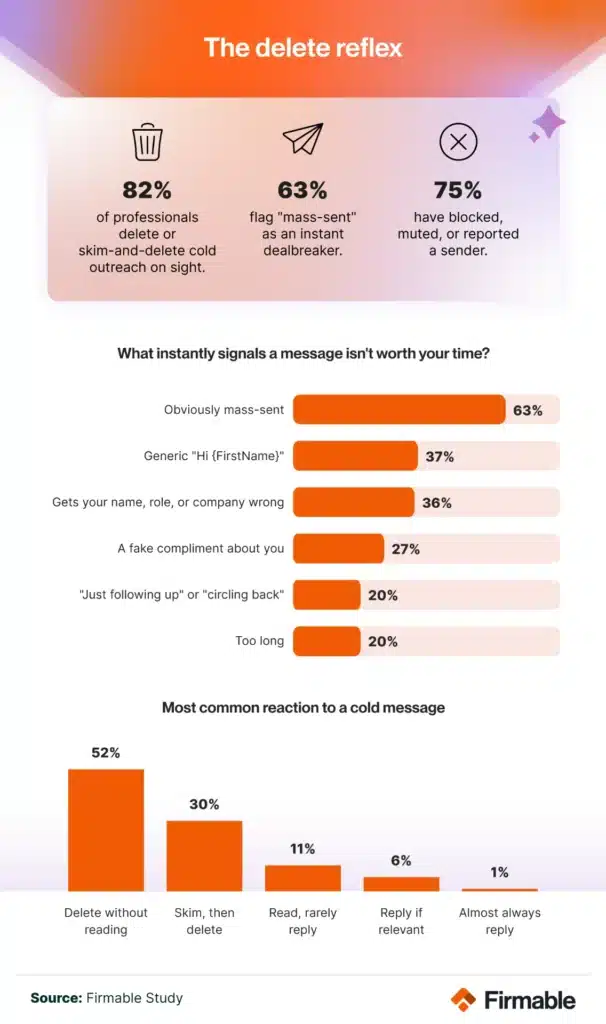
Overall, 82% of professionals delete or skim-and-delete cold outreach on sight, including 85% of women and 77% of men. More than half of professionals (52%) delete without reading a single word, and among government and nonprofit workers, that climbs to 61%. Just 1% of professionals almost always reply to cold messages.
What gets a message killed fastest is looking mass-sent, which 63% flag as an instant dealbreaker. That beats a generic “Hi {FirstName}” (37%) and getting your name, role, or company wrong (36%).
In a typical week, 44% of professionals receive 6 or more cold messages, with 16% fielding 16 or more. Gen X takes the brunt: 60% get 6 or more, compared to 40% of millennials and 38% of Gen Z. Little wonder that 75% have blocked, muted, or reported a sender, and 38% have replied to a stranger just to make the messages stop.
The people who resent cold outreach send it too
The people deleting all this outreach are often the same people sending it.
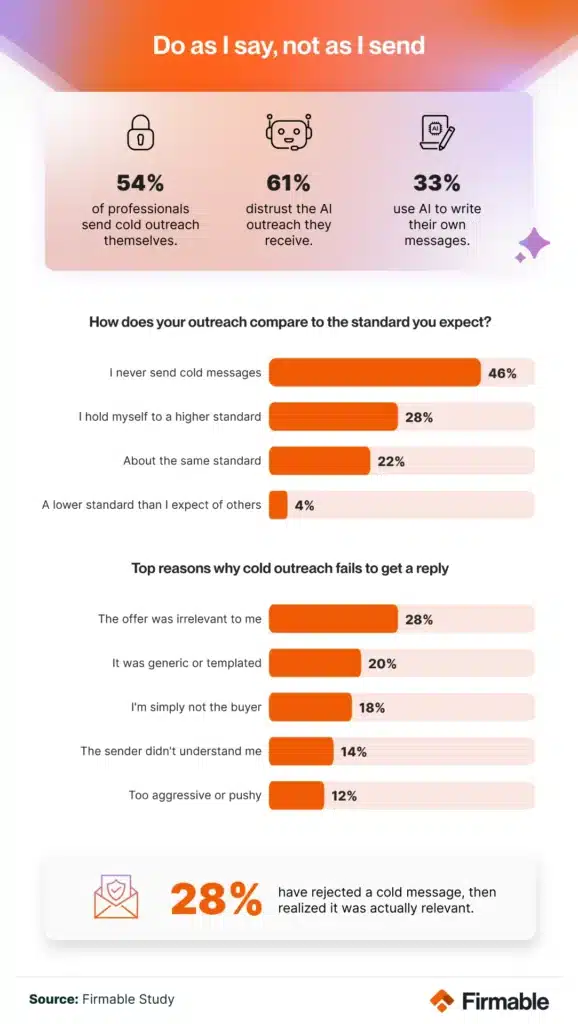
More than half of professionals (54%) send cold outreach themselves. Gen Z sends the most, with 28% cold-messaging a stranger in the past year for a job, vendor, intro, or favor. Fewer Gen X (21%) and millennials (18%) did the same.
Among those who send, 22% hold themselves to about the same standard, and just 4% to a lower one, than they expect from others.
When outreach fails, people most often blame the message, saying that the offer was irrelevant to them (28%). Others say it was generic or templated (20%). The reflex to reject these messages can come with a cost. More than 1 in 4 (28%) have turned down a cold message only to realize it was relevant. Mistakes like this most often happen among Gen Z (32%).
There’s also an AI double standard among respondents. While 61% distrust the AI outreach they receive, 33% use AI to help write their own cold or professional messages (rising to 47% in tech and 43% in financial services). Men also rely on AI more than women when drafting cold messages (39% vs. 30%).
People reject fake outreach, not AI
People distrust AI outreach, but that isn’t really the objection. What they reject is outreach that feels fake, whether it was written by a human or a machine.
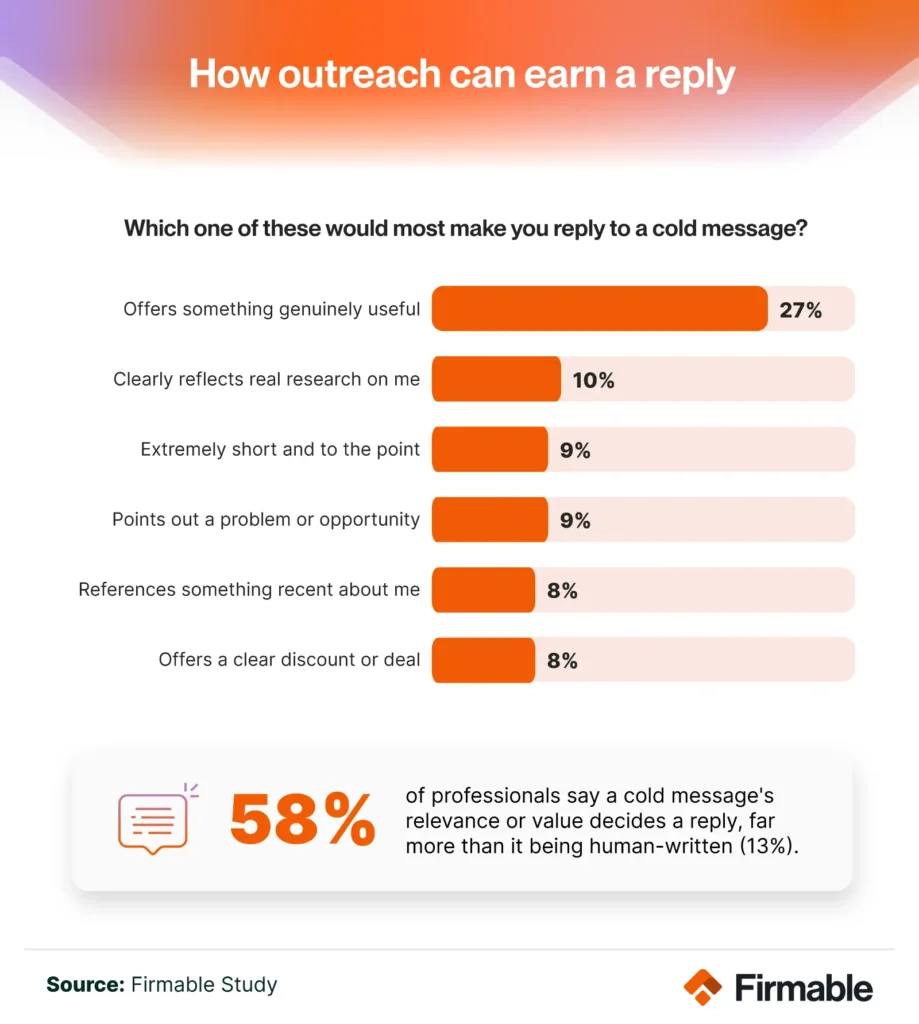
Alt text: Chart showing 58% reply for relevance or value, while only 13% care whether a human wrote the message
A full 61% of professionals say an AI-generated “personalized” video, like a Loom, feels fake and makes them less likely to engage, while only 7% find it impressive. Gen Z was most likely to say videos like these feel fake (70%), followed by millennials (61%) and Gen X (53%).
Two-thirds (67%) say they can spot AI-written outreach and ignore it, with the share rising to 75% in healthcare. Tech is the exception, where 20% find AI video impressive, nearly three times the average, though 49% in that industry still call it fake.
But authorship matters less than it seems. Only 13% say a human writing the message is what counts most when deciding whether to reply, while 58% care more about relevance or genuine value.
What earns a reply is the message containing something genuinely useful, such as data, an intro, or a resource, chosen by 26% of professionals. Others say they reply to messages that clearly reflect the sender did research on them, and they also prefer messages to be extremely short and to the point.
What this means if you send cold outreach
None of this means cold outreach is dead. It means the bar moved. The senders who still get replies aren’t the ones with the slickest templates, but the ones who show up with the right context. They know who someone is, what they’re dealing with, and why the timing makes sense. That’s not about writing better. It’s about knowing how to provide more relevance and value before you hit send.
Methodology
For this campaign, we surveyed 1,009 full-time professionals to explore how they feel about cold B2B outreach in 2026, both the messages they delete on sight and the ones they send themselves. Among them, 62% were women, 36% were men, and 2% identified another way or preferred not to say. Generationally, 17% were Gen Z, 60% were millennials, 20% were Gen X, and 2% were baby boomers.
About Firmable
Firmable is the AI-native sales intelligence platform for B2B sales teams, providing the most complete prospect data, buying signals, and agent-driven actions to help you win more deals. As the salesperson’s favorite teammate, we don’t just give you data – we give you direction, whatever tool you work in.
Firmable’s agentic technology, built from the ground up, sources, assembles, and continuously refreshes a proprietary map of the market. It delivers the richest company and contact details, including data you won’t find anywhere else, to sales teams across the United States, Canada, and APAC.
Fair use statement
You’re welcome to share the findings and visuals from this study for noncommercial purposes. When you do, please credit Firmable as the source and link back to this page so readers can see the full methodology.