

What does the next generation of B2B go-to-market actually look like? Not the LinkedIn hype version. Not the “AI will replace every salesperson by Friday” version. But the practical version of an AI go-to-market strategy.
Rakesh Patni has seen this shift from multiple angles. He has built businesses from scratch, scaled a trading business to tens of millions in revenue, founded B2B SaaS companies, advised global technology leaders, and led AI and automation research across Asia-Pacific and Japan at IDC.
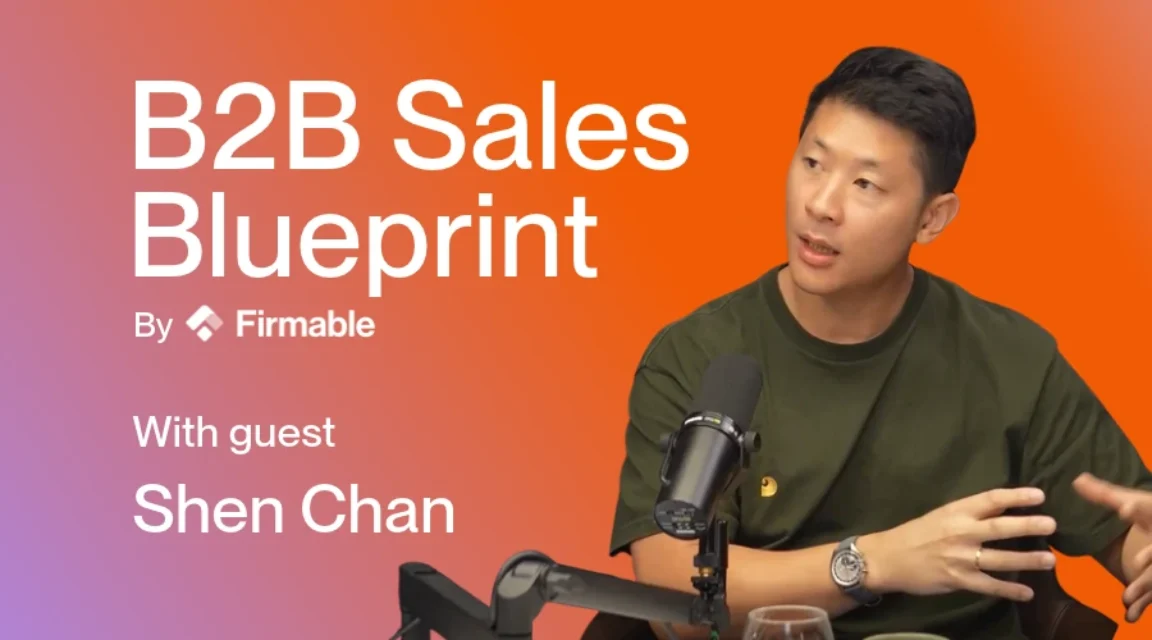
In episode seven of B2B Sales Blueprint, Firmable’s co-founder and Co-CEO Paul Perrett sat down with Rakesh in Singapore to talk about what AI really changes in sales, what it does not change, and why the next era of go-to-market will be built around systems, signals, automation, and human judgement.
The big takeaway is simple: sales teams do not just need more reps. They need better systems.
Here are six lessons every founder, CRO, sales leader, and RevOps operator should take from the conversation.
1. Trust is still the foundation of sales
Before the conversation gets into AI agents, GTM engineering, and automation, Rakesh starts somewhere much more fundamental: trust.
His earliest sales lessons came from a commodities trading business, where deals were built on reliability, reputation, and relationships. There was no sophisticated tech stack. There was no automated sequence. There was no intent dashboard. There was just the question every buyer asks, whether they say it out loud or not:
“Can I trust this person? Without that trust, you’re not getting anywhere.”
Why trust still matters in an AI-enabled sales world
The direct answer: AI can improve speed, research, prioritixation, and productivity. It cannot replace the trust required to move a buyer through a meaningful commercial decision.
That is especially true in B2B sales, where deals often involve multiple stakeholders, long evaluation cycles, risk, procurement, implementation concerns, and internal politics. Buyers are not just choosing a product. They are choosing whether to believe the person and company behind it.
AI can help the salesperson show up better informed. It can surface account context. It can summarize calls. It can help identify the right moment to reach out. But the human still has to build credibility.
What sales teams should do
- Audit your sales motion for trust gaps.
- Look at your outbound, discovery, follow-up, proposals, and handovers. Are you creating confidence at every stage, or just pushing for the next meeting?
The best sales teams will use AI to remove low-value admin so reps can spend more time doing the high-value human work: listening, understanding pain, earning credibility, and helping buyers make confident decisions.
2. AI will rewrite manual SDR work
One of Rakesh’s clearest points is that the manual work sitting underneath outbound sales is being rewritten.
For years, SDRs have been asked to pull together data from disconnected sources, build lists, check contacts, research accounts, find snippets of context, write outreach, log activity, and keep the CRM updated.
Some of that work is valuable. A lot of it is repetitive.
“Those manual processes will be fundamentally rewritten.”
What AI changes in outbound sales
The direct answer: AI changes outbound by compressing the manual work between identifying an account and taking the right action.
That does not mean the SDR role disappears. It means the shape of the role changes. SDRs will spend less time stitching together basic data and more time acting on high-quality context, interpreting signals, testing messaging, and engaging the right buyers at the right time.
This is where many teams get AI wrong. They think the goal is to automate more emails. The better goal of an AI go-to-market strategy is to improve the quality and timing of every sales action.
Why this matters
If your SDR team is spending most of its time finding data, cleaning lists, checking job titles, and guessing who to prioritise, you do not have a sales productivity problem. You have a GTM system problem.
The future SDR team will not be measured only by activity volume. It will be measured by how well it uses data, signals, and AI-assisted workflows to create qualified conversations.
What to do this week
- Map the first 10 steps an SDR takes before making contact with a prospect.
- Where are they looking for data? Where are they copying information between tools? Where are they manually checking things AI could assist with? Where are they guessing?
That map will show you where AI can create real leverage.
3. Leads are not enough. Signals are the new advantage
Most outbound teams know who they want to sell to. Far fewer know when those accounts are most likely to care.
That distinction matters.
Rakesh argues that static lead data is no longer enough. You still need accurate company and contact data, but the next layer is knowing what is happening inside and around those accounts.
Are they hiring? Changing leadership? Showing interest in a relevant topic? Opening new roles? Adopting technology? Entering a new market?
Those are the moments that change prioritization.
“It’s not enough knowing about the lead itself. There’s also a trigger that should come into play.”
Why buying signals change outbound prioritization
The direct answer: buying signals help sales teams move from “who fits our ICP?” to “who fits our ICP and has a reason to talk now?”
That is a major shift.
A company might be a perfect fit on paper, but have no urgency. Another company might be slightly smaller, but has just hired six SDRs, appointed a new CRO, or started researching a problem your product solves.
The second account will likely be the better use of your team’s time.
Why this matters for sales leaders
Without signals, outbound teams tend to over-rely on volume. They build big lists, run broad sequences, and hope enough people respond.
With signals, the motion becomes more focused. Reps can prioritize accounts based on timing, context, and relevance. That means better outreach, better conversion, and less wasted effort.
What to do
Review your current ICP list and ask: what events would make an account more likely to buy from us in the next 30 to 90 days?
Examples might include:
- Hiring sales or RevOps roles
- Leadership changes
- Funding announcements
- Expansion into new markets
- New technology adoption
- Search intent around relevant topics
- Customer movement into target accounts
- Product launches or operational changes
Once you define those triggers, your outbound motion becomes much sharper.
4. With an AI go-to-market strategy, GTM becomes a system you design
One of the strongest ideas discussed is Paul and Rakesh’s shared view that go-to-market is increasingly something you architect.
Not just a team. Not just a CRM. Not just a sequence.
A system.
“Go-to-market is increasingly a system that you build and architect. It’s like a product.”
What it means to treat GTM like a system
The direct answer: treating GTM as a system means designing how data, signals, tools, people, workflows, and decisions connect across the revenue engine.
In a traditional sales motion, a lot of this happens manually. A rep finds a contact. They research the company. They write outreach. They update the CRM. They create a task. They follow up. They hopefully remember the context.
In an AI-enabled GTM system, much of that workflow can be connected. Data flows into enrichment. Signals inform prioritization. AI helps generate account context. CRM tasks are created for the right owner. Reps act with more clarity.
The goal is not automation for its own sake. The goal is decision velocity.
Why velocity becomes the advantage
Rakesh puts it simply:
“If you can move faster than your competitors, then you have a competitive edge.”
In B2B sales, speed matters. Not reckless speed. Informed speed.
The team that spots a buying signal first, understands the account fastest, reaches out with relevant context, and follows up with discipline has an advantage over the team that takes two weeks to build a list and another week to write generic messaging.
What sales leaders should do
Stop looking at your sales stack as a set of separate tools. Look at it as a workflow.
Ask:
- Where does account data come from?
- How is it enriched?
- How are signals detected?
- How are accounts prioritized?
- How does that context reach the rep?
- What gets pushed into the CRM?
- What action should happen next?
- Where does human judgement need to stay in the loop?
That is the start of GTM system design.
5. GTM engineering is becoming a real function
As go-to-market becomes more systemized, a new role starts to emerge: the GTM engineer.
Rakesh describes this as the person or function responsible for building the plumbing behind modern revenue teams. They connect tools, workflows, data, automation, CRM tasks, enrichment, outbound systems, and AI agents.
“There’s kind of a new function coming into play here, which you could dub something like GTM engineering.”
What does a GTM engineer actually do?
The direct answer: a GTM engineer designs the workflows that help revenue teams move faster and make better decisions.
They are not just building campaigns. They are building the operating system behind the campaign.
That might include connecting sales intelligence data to enrichment tools, routing signals into CRM workflows, triggering tasks for SDRs or AEs, creating automations for account research, or ensuring data moves cleanly between systems.
The role sits somewhere between RevOps, sales operations, growth, automation, and systems design.
Why this matters to delivering an AI go-to-market strategy
Most companies have added more sales tools over the past decade. Fewer have designed how those tools should work together.
That creates a common problem: the team has more software, but not necessarily more leverage.
A GTM engineer helps turn the stack into a system. That matters even more as AI agents become part of the workflow, because agents need clean inputs, clear rules, defined tasks, and well-designed handoffs.
What to do before hiring a GTM engineer
You may not need a dedicated GTM engineer on day one. But you do need someone accountable for the system.
Start by documenting your core revenue workflows. Then identify where data breaks, where reps lose time, where CRM hygiene fails, and where manual work slows momentum.
That gives you a roadmap for what a GTM engineering function would eventually own as you roll out an AI go-to-market strategy.
6. AI will change sales roles, but adaptability still wins
The most practical part of the conversation is Rakesh’s view on people.
When Paul asks what sales leaders should look for in a rep in an AI-native world, Rakesh does not start with technical skills. He starts with attitude.
“The first thing I look for is attitude. The second thing I look for is a love for learning.”
That answer matters because AI is changing how sales work gets done. The best reps will not necessarily be the ones with the most experience in the old playbook. They will be the ones who can learn, adapt, experiment, and use technology to improve their performance.
What makes a great sales hire now?
The direct answer: attitude, curiosity, coachability, and adaptability matter more than ever.
Skills still matter. Commercial acumen still matters. Communication still matters. But in a changing environment, the ability to learn may be the most valuable trait.
A rep who is curious about AI, willing to test new workflows, and disciplined enough to use better systems will outperform a rep who insists on doing everything the old way.
How sales manager roles change
This also changes the role of the sales manager.
Sales managers are no longer just coaching calls, reviewing pipeline, and holding reps to activity metrics. Increasingly, they need to understand the process their reps are working inside.
They need to coach people on how to use AI well. They need to understand where the workflow helps and where it creates noise. They need to reinforce better habits around data, prioritisation, and follow-up.
In other words, sales managers also need to become systems thinkers.
What to do
Update your hiring and coaching scorecards. Add questions like:
- Does this person actively learn new tools?
- Can they explain how they use AI in their workflow?
- Are they curious about process improvement?
- Do they adapt when the playbook changes?
- Can they combine automation with human judgement?
These questions will matter more as the gap widens between reps who use AI as leverage and reps who treat it as a shortcut.
7. AI agents should start with specific tasks, not vague ambition
AI agents are one of the most talked-about concepts in go-to-market, and key to an AI go-to-market strategy. But they are also one of the least clearly understood. Rakesh’s advice is practical: start small.
Do not begin with “we need an AI agent strategy”. Begin with a specific workflow and a specific task.
For example, an agent might identify high-priority accounts from a list, check for relevant signals, enrich account context, recommend the next action, and create a task in the CRM for the right owner.
That is useful. Dumping thousands of AI-generated contacts into your CRM is not.
Why AI can make your CRM messier
The direct answer: AI without workflow design can create more noise than value.
Rakesh warns against suddenly pushing large volumes of unqualified accounts or opportunities into the CRM. Once bad data or poorly qualified records enter the system, they are hard to unwind.
AI should help qualify, prioritize, and prescribe action. It should not simply create more clutter.
What an AI agent should do first
Start with controlled, discrete use cases. Good early examples include:
- Summarizing account research
- Identifying buying signals
- Ranking accounts by fit and timing
- Creating CRM tasks for high-priority accounts
- Summarizing calls and next steps
- Supporting deal reviews against a sales methodology
- Drafting personalized outreach based on approved inputs
The key is to keep the task clear and the human handoff obvious.
The bottom line for your AI go-to-market strategy
Rakesh Patni’s view of the future of sales is neither panic nor hype.
AI will change go-to-market. It will rewrite manual workflows. It will make buying signals more important. It will create new roles like GTM engineering. It will give the best reps and managers more leverage. Over time, it may also compress parts of the sales organization as agents take on more work.
But the fundamentals do not disappear.
Trust still matters. Data quality still matters. Human judgement still matters. Sales still requires credibility, timing, context, and relationships.
The difference is that the ceiling is changing.
The best sales teams will not just hire more reps and push for more activity. They will build systems that help their people move faster, act smarter, and focus on the work that actually creates pipeline.
That is what the next era of B2B go-to-market looks like: better data, sharper signals, smarter workflows, AI agents in the background, and humans doing the work only humans can do.
If you are building or scaling a B2B sales function, explore how Firmable helps sales teams build accurate prospect lists, monitor buying signals, and move faster with better go-to-market intelligence.
Listen to the full episode with Rakesh Patni on B2B Sales Blueprint, hosted by Paul Perrett, co-founder and Co-CEO of Firmable.
Frequently asked questions about AI go-to-market strategy
An AI go-to-market strategy is a plan for using AI across the revenue engine to improve how a business identifies, prioritizes, engages, and converts target accounts. It includes data quality, buying signals, account research, workflow automation, CRM enrichment, sales coaching, and AI-assisted decision-making. The best AI go-to-market strategies do not start with tools. They start by mapping the sales process, identifying manual work, and deciding where AI can improve speed, quality, or consistency.
AI is changing B2B sales by reducing manual research, improving account prioritization, surfacing buying signals, helping reps personalize outreach, summarizing customer conversations, and supporting sales managers with coaching and deal reviews. It is not simply replacing salespeople. In the near term, AI is giving strong salespeople more leverage by helping them make faster, better-informed decisions.
Buying signals are events or behaviors that suggest a company may be more likely to buy. Examples include hiring new sales roles, appointing a new executive, raising funding, expanding into a new market, adopting new technology, or showing intent around a relevant topic. Buying signals matter because they help sales teams prioritize accounts based on timing, not just fit.
GTM engineering is the function responsible for designing and connecting the systems behind go-to-market. It brings together data, enrichment, signals, CRM workflows, outbound tools, automation, and AI agents so revenue teams can work faster and more effectively. A GTM engineer focuses on the plumbing of the revenue engine: how data moves, how actions are triggered, and how reps receive the right context at the right time.
AI is unlikely to replace all SDRs and salespeople in the near term, but it will change their roles. Reps will spend less time on manual research, admin, and list-building, and more time on judgement, prioritization, customer conversations, and strategic follow-up. Over time, some repetitive sales work may be handled by AI agents. The reps who adapt and learn how to work with AI will have a major advantage.
Sales leaders should start by mapping their current sales workflow and identifying the most repetitive, time-consuming tasks. Common starting points include account research, CRM enrichment, buying signal detection, call summarization, follow-up notes, and task creation. The goal is not to automate everything at once. The best starting point is one clear workflow where AI can reduce manual effort, improve decision quality, or help the team act faster.