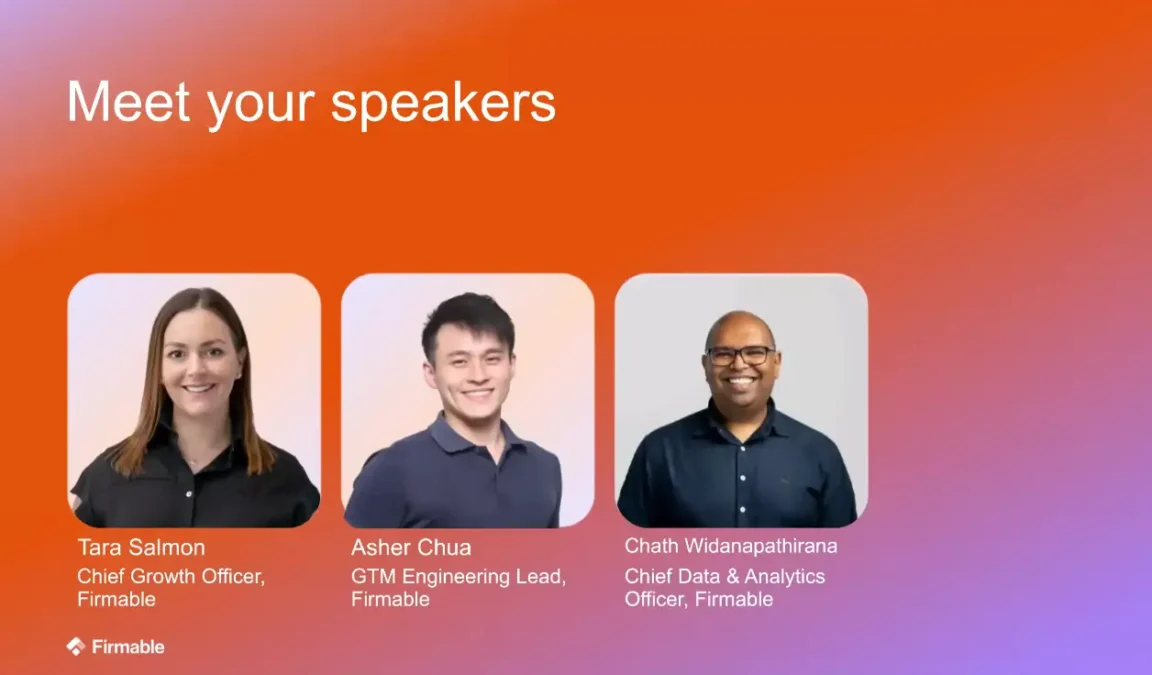

Knowing which technology a company runs can shape who you target, what you say and when you say it. The problem is that most technology data is thinner and older than it looks. In a recent Firmable webinar, Tara Salmon (chief growth officer) hosted Asher Chua (GTM engineering lead) and me for a session on tech intelligence: how it works, how it differs from traditional technographics and how teams are using it. If you missed it, here is what you need to know.
Tech intelligence data is a date-stamped, confidence-scored view of the technology a business runs, built from direct observation rather than inference. It covers software, cloud footprint, infrastructure, devices and AI tooling, and it links each observation to a company and its contacts.
Key takeaways
- Most technographics only see the surface of a company’s technology.
- Observing internet infrastructure gives stronger evidence than reading websites and job ads.
- Useful tech data comes with recency, confidence and evidence.
- There are four practical use cases: competitor displacement, complementary tools, service partnerships and market insights.
- Tech stack, signals and people data together beat a generic pitch.
- The data is most useful when it reaches the tools you already work in, including AI assistants.
[Continued below]
1. Most technographics only see the surface
Traditional technographics rely on two sources, and both have limits. The first is the company’s marketing website. If a HubSpot form is embedded, the company is assumed to use HubSpot. The second source is job ads, which are run through large language models to pull out technology names.
I explained the weakness in each in the webinar. A website only shows what is on the marketing site. A job ad shows what a company might be running, which means you are making assumptions. A company advertising for someone with Salesforce or HubSpot administration experience gets tagged with both, even if it only runs one. Tags left on a site after a company has dropped a tool create stale data on top of that.
The result is gaps, outdated records and low-confidence signals, which is why reps so often look up a technology and find nothing useful.
2. Observing internet infrastructure gives stronger evidence
The most reliable evidence of a company’s technology comes from how the internet itself is built. Firmable’s AI-native approach starts at the infrastructure layer and works up, and it has two main parts.
The first is the Domain Name System (DNS), the address book of the internet. DNS records reveal which mail systems a company uses, whether it self-hosts and which services it runs. Because organizations control their own DNS, whatever appears there is first-party evidence. Firmable tracks around 8 billion of these records.
The second is scanning the public-facing internet. Firmable scans weekly and, as I said, this produces around 4 billion observations a day. Those scans detect patterns that point to self-hosted systems, network appliances, security tools and software approaching end of life. This is how Firmable can see back-office and infrastructure technology that never appears on a website, from cloud footprints and hardware to the AI tooling a development team has deployed.
Firmable only observes what a company exposes publicly. It never logs in and never goes beyond what is public-facing on a company’s network.
The scale is growing quickly. As of the webinar in mid-November 2026, Firmable tracked 88,000 technologies, up from 33,000 about two weeks earlier. An agentic AI system continually finds new technologies and patterns. Tech intelligence data covers over 20 million businesses and around half a billion installs, where an install means one technology seen at one organization.
3. Useful tech data comes with recency, confidence and evidence
Knowing a company uses a technology matters less than knowing how sure you can be. We spoke about four things that make tech data usable:
- A last-seen date. You want to call someone knowing the technology was observed recently, not at some unknown point in the past.
- A confidence score. This reflects how often the technology is seen and how strong the signal is, among other factors. Marketing could run a campaign based on ‘moderate’ confidence of the technology used at target companies. But an Account Exec might filter for ‘high’ confidence on the same list before reaching out to senior prospects.
- Evidence. Firmable is working on showing users why it believes a company runs a technology, not just that it does.
- Verified contacts. Each business comes with contacts, and you can target the roles that make purchase decisions, such as a Chief AI Officer or CISO.
This is a good checklist for evaluating any tech-stack data source. If it cannot tell you when it saw something and how confident it is, treat it with caution.
4. Four practical use cases
Tech stack data supports four distinct plays. Asher walked through each.
- Competitor displacement. Find companies using a competing product, then lead with the pain points customers of that product typically face.
- Complementary tools. Find companies using products you integrate with or add value on top of. Chath also suggested searching for combinations, such as organizations using two related tools, since that signals heavy adoption.
- Service partnerships. If you consult on or implement a technology, vendors rarely hand over their customer lists. With tech data, you can identify users of that technology yourself, start the conversation first and then bring the vendor in. The vendor now has an incentive to help you win the deal together.
- Market insights. Regional and sales leaders can layer tech stack onto a total addressable market map. Industry and headcount show who fits. Tech stack shows who has a pain point you can solve, such as which companies in Singapore or South Carolina use your competitors.
5. Tech stack, signals and people data beat a generic pitch
Tech intelligence data is the start of targeting, not the end. Asher’s point was that most sales teams want something they can use from week one, with one search and not a patchwork of tools.
His demo showed the workflow in Firmable:
- Search for companies using a particular CRM or a competing data tool. Filtered for an ANZ webinar audience, this returned 580 companies.
- Add them to a list and apply a signal agent that looks for new sales leaders (director level and above) who started in the last 90 days. New leaders often bring new initiatives and budgets.
- The result was 144 people to approach, each with verified contact details.
The difference shows up in the message. Asher contrasted a generic cold email (all about the sender, nothing about the recipient) with one built from tech intelligence data: a move from on-premises to cloud, a newly hired leader or new sites opening. You may not write exactly like his example, but the principle holds. Relevance comes from specifics you can prove.
6. The data is most useful where you already work
Tech intelligence is available in the Firmable app, through MCP connectors for AI assistants, via API, by download and through CRM sync. The demo of MCP in Claude made the case for AI-assisted prospecting.
Asher gave Claude a one-shot prompt as a seller of AI customer support, without naming a competitor or an integration partner. Claude reasoned out which competitor to displace and which tools to look for, then used Firmable’s data to return a list of people, each with a reason to reach out. The same approach as an observability vendor returned a list of new hires.
His tip: give the AI context about your business, such as a markdown file describing your product, customers and positioning. Better context produces better targeting. The MCP also works with Chat GPT and Microsoft Copilot.
For teams that cannot connect an AI assistant, or that want to automate lookups, Firmable’s data API launches on December 2, 2026. Asher showed it enriching an inbound lead through a workflow tool and pulling full tech stacks for a list of domains in Clay.
Frequently asked questions about Tech Intelligence
Yes, it covers many niche technologies. As I said in the webinar, the AI system does not care whether a technology is widely adopted or obscure. It picks up whatever it can observe. In recent customer conversations, vendors with as few as 400 installs have still shown up in the data. Coverage spans all industries and company sizes. If a technology you care about is missing, you can request it through support and it can be added to the next round of scans.
New products are picked up automatically as they launch, and the team can nudge the system if something is missing. A product launched in the last day or two may not appear yet. Because the internet is scanned weekly, you can also see how a technology’s presence changes over time.
Not currently. Renewal dates are a different type of data from technographics. They are something Firmable is exploring, but they are not available today. What you can do is combine tech intelligence data with signals. Firmable tracks 35 to 40 company signals, such as new market launches, product announcements and leadership changes, and you can stack one or several into a single signal agent.
You have other options. You can work in the Firmable app, sync data to your CRM, download it for offline work or use the data API when it launches on December 2, 2026. Connecting an AI assistant gives you the most reasoning power, but it is not required.
See what your market is running
Tech Intelligence data only proves its value on your own target market. Pick a competitor, an integration partner or a technology you consult on, and search for the companies running it. Then layer on a signal and look at the people behind the accounts.
Enter the tech stack you target at firmable.ai/tech-intelligence to see a sample of the data available.