
 Apple Podcasts
 Spotify
 YouTube
About this episode
Everyone with a view on low ACV outbound sales says an $8–10K contract value is too low to justify a BDR team.
Kyle Norton built a profitable outbound engine at exactly that price point – and helped scale owner.com from $2M to nearly $100M ARR doing it.
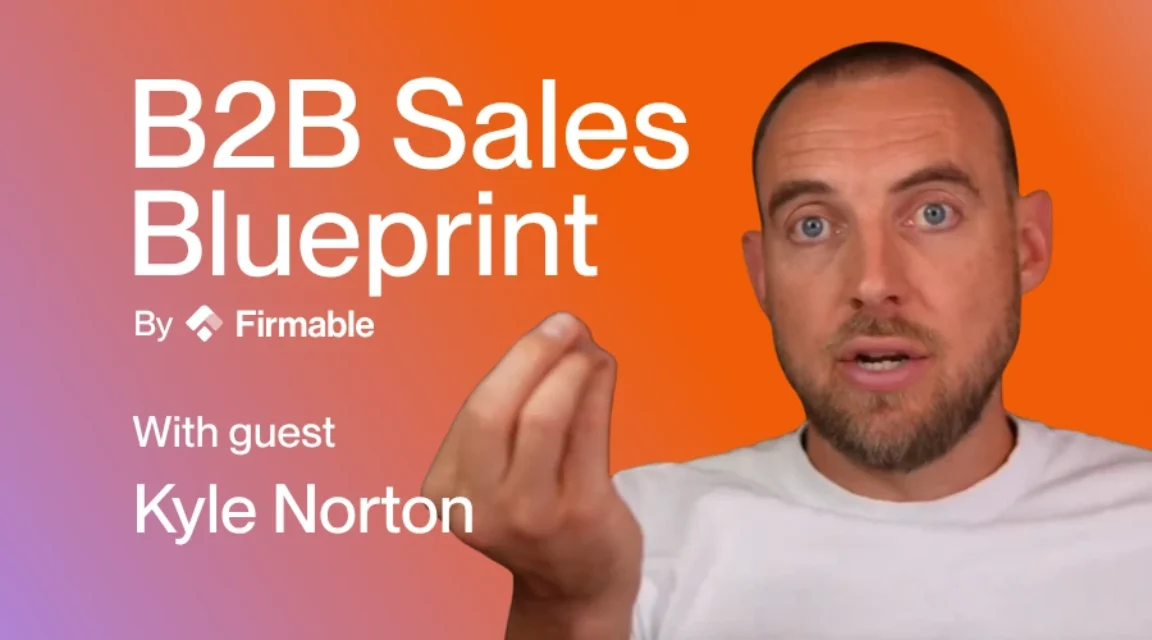
In this episode of the B2B Sales Blueprint, Paul Perrett (Co-founder & Co-CEO, Firmable) sits down with Kyle Norton, until recently CRO at owner.com, to unpack the contrarian GTM decisions behind one of the fastest-growing vertical SaaS companies in the world.
Kyle explains why he replaces “best practice” with “high probability practice,” how to reason from first principles to make low-ACV outbound work, and why the real bottleneck in AI adoption isn’t the technology – it’s change management.
He also walks through his four-level framework for AI sales sophistication, from simple prompts to a full GTM “harness” to recursive, self-improving revenue systems – plus how the CRO role itself is being rewritten.
Whether you run a sales team, own GTM strategy, or are figuring out how AI actually changes revenue operations, this one is packed with practical, hard-won takeaways.
Key topics covered
– Why low ACV outbound sales can be wildly profitable (and the math that proves it)
– The friction-removal mindset that gets reps to adopt AI
– The 4-level AI sophistication ladder and what a “GTM harness” really is
– Why the data layer is non-negotiable groundwork
– How the modern CRO must think like a systems architect
– Building a culture of “rugged flexibility” and servant leadership
Timestamps:
- [6:55] – Deal size & the 6-day sales cycle
- [8:24] – The contrarian bet: “high probability practice,” not best practice
- [9:57] – The math that makes low ACV outbound sales work
- [10:50] – Time studies, ride-alongs & removing rep friction
- [12:46] – The real secret: change management, not AI
- [14:05] – Building a culture that leans into change
- [16:45] – Trust: why the team isn’t afraid of AI
- [17:56] – Choosing the right first AI project
- [19:12] – “No new surfaces” & the friction-removal mindset
- [22:06] – A different buyer: how it changes who you hire
- [23:22] – Hiring grads & why sales craft doesn’t predict success
- [24:38] – Operating cadence: “chop wood, carry water”
- [27:38] – The AI sophistication ladder (levels 0–4)
- [28:41] – Level 3 explained: the GTM harness
- [34:09] – Level 4: recursive GTM intelligence
- [36:06] – Why the data layer comes first
- [37:00] – Making the level 2 → 3 leap
- [40:10] – The new CRO: part systems architect
- [42:00] – Building a balanced leadership team
- [43:40] – Setting the tone as a leader
Notable quotes from Kyle Norton
On “best practices” vs. reality:
“I try not to say best practice. I try to say high probability practice… those are high probability practices that have maybe been true in many environments, but you have to think from first principles always and decide if that is still true for your environment, because AI is changing all of it.”
On why owner.com’s AI adoption actually works:
“We’re actually not doing too many things that other people aren’t trying to do. I really think the secret to our success has been our ability to change behavior… the secret to why we’ve been able to adopt so much AI is actually the agility and change literacy of the organization.”
On the four levels of GTM AI sophistication:
“Level four is a recursive go-to-market intelligence where you have a harness, you have managed context and memory, you have your network of agents… Nobody’s here yet. This recursive place is the takeoff – like in AI language, when AI starts making AI better.”
On leadership and being true to yourself:
“I tell people you’ve got to lean into who you are… people have to be honest with who they are and do those things and live their values. And if those values take you one place or another, just living in congruence, I think, is important.”
Who This Episode Is For
This episode is for revenue and sales leaders wrestling with how AI is actually reshaping go-to-market execution, not just the theory of it. It’s especially useful for anyone leading a high-velocity, transactional sales motion (SMB or mid-market) who’s been told their deal size is “too small” for outbound or SDRs, since Kyle directly challenges that conventional wisdom with real math from owner.com’s $8-12K ACV, 6-day sales cycle business.
It will also resonate with operators further along in their AI journey who want a concrete maturity framework (his four-level sophistication ladder, from ad-hoc AI use to a fully recursive GTM intelligence layer) rather than vague “AI-first” slogans.
Finally, it’s valuable for leaders focused on culture and change management, since Kyle argues the hard part of AI transformation isn’t the tooling, it’s getting a team to actually adopt new behavior.
FAQs on low ACV outbound sales
No. Kyle Norton argues this is only true depending on the math of your specific sales environment. At owner.com, an $8-12K ACV business, outbound works because win rates are high and reps spend very little time per deal, making the unit economics of outbound viable.
Level 1 is using AI as a Google-search replacement; Level 2 involves shared skills, workflows, and prompt libraries; Level 3 means building a full “GTM harness”: integrated tools, context, and governance around models; Level 4 is a recursive system where AI improves the AI tools themselves, which Kyle says almost no GTM organization has reached yet
A GTM harness is the shared infrastructure – tool integrations, baseline prompts, ICP context, playbooks, and governance rules – that sits around an LLM so every new agent a team builds draws on the same consistent foundation instead of starting from scratch.
Kyle Norton attributes low AI adoption less to weak tooling and more to poor change management. He emphasizes reducing friction (no new tabs or surfaces), building trust with reps, and choosing early AI use cases carefully, since the first thing a team tries shapes whether people lean into future AI tools or grow skeptical of them.
Owner.com uses a structured cadence, including a “Chop Wood Carry Water” block, where managers spend the first three hours of each day on the front lines with reps rather than in meetings, plus systems like “AI routing” that prioritize which leads reps call first.
According to Kyle Norton, owner.com’s data showed that demonstrated sales craft in interviews has little correlation with on-the-job performance. Instead, they prioritize hardworking, coachable, mission-driven hires (often straight out of college) and rely on strong enablement and onboarding to build the sales skills.
Next steps
- Subscribe to the B2B Sales Blueprint for conversations with operators who have done the work.
- See how Firmable powers the data layer behind high-performance outbound teams, with a free trial.